

Cognitive Dissidents
Making a choice when the dissonance breaks

I don’t like getting political, but I feel that the current state of things is so philosophically and morally preposterous that I must talk about it. I struggled terribly with how to discuss this, so I decided holding up a mirror was the best way. If you are upset by this, perhaps you identify with the reflection.
Meet Anita
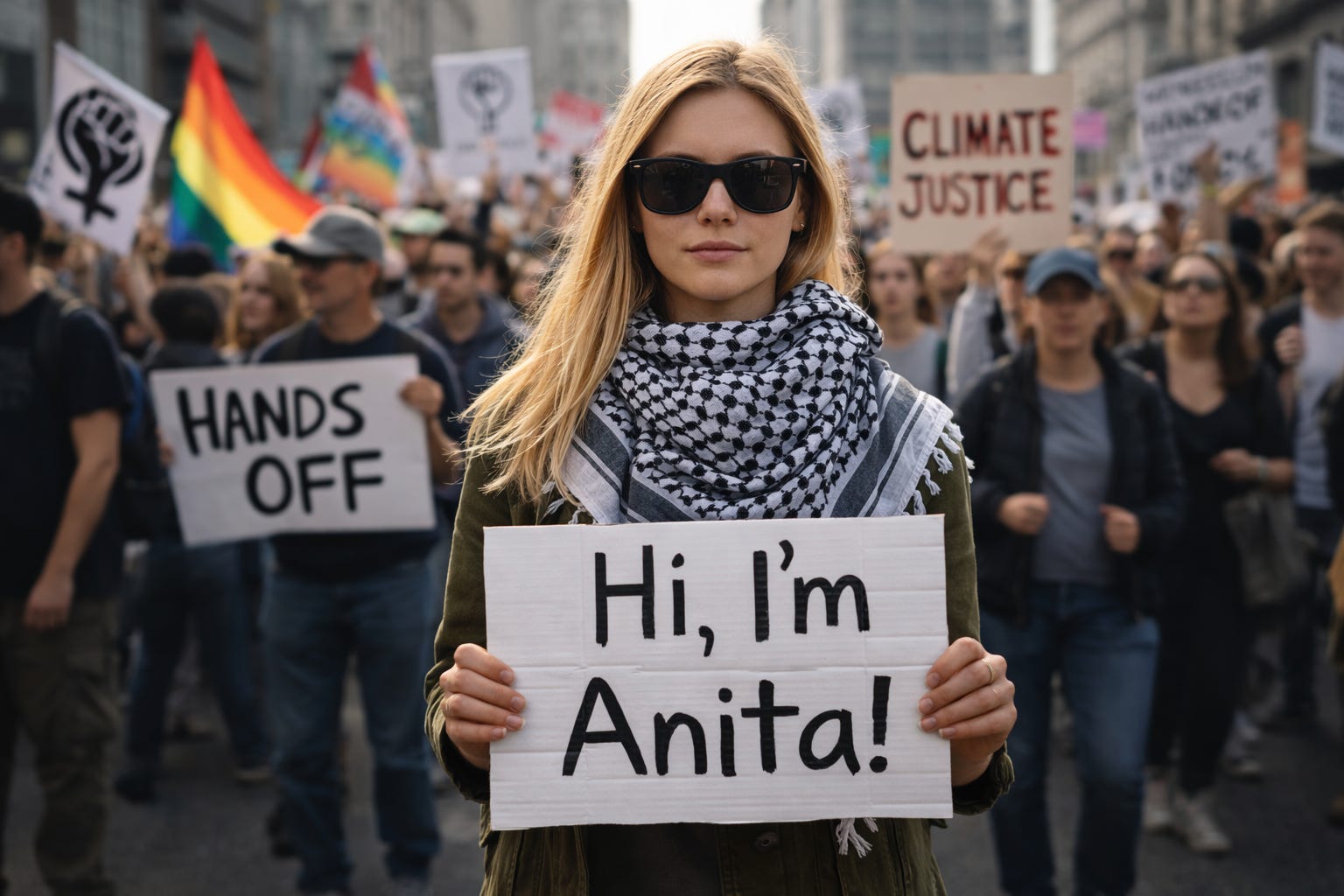
Anita B. Goode is a twenty-four-year-old student at a prestigious university. Although Anita is cis, white, and straight, she more than makes up for her privileged identity by directing her efforts towards people she perceives as needing all the help they can get. Anita would be the first to tell you that she’s a feminist, a champion of democracy, a proud defender of LGBTQ+ rights, is defiant in the face of capitalist exploitation, and the keffiyeh she wears signals from afar that she stands with the Palestinians against Israel.
She keeps up to date on current events mainly through TikTok and Instagram, as well as through conversations with her professors and fellow students. The experts around her keep her as informed as she needs to be, and she is proud to stand for whatever cause needs her. And she does; she’s a dedicated student activist. It started with climate and shifted over time as the attitudes on campus changed.
Pioneer of moral psychology Lawrence Kohlberg would have described her as “conventionally moral,” meaning her moral judgments and attitudes are absorbed from her social surroundings. She has an “interpersonal accord and conformity” orientation, which means her values are subconsciously driven to secure her place within her in-group as accepted and virtuous.
According to research, only about 10–15% make it to postconventional morality, in which people make moral judgments outside of conventional attitudes, meaning the overwhelming majority of people adopt their morals from their surroundings, much like Anita.
Anita is strongly driven to do the right thing, and the crowd is assuring her she’s doing so excellently. That’s good enough for her. If the people she likes and trusts tell her she’s fighting the good fight and doing it well, no further moral clarification is necessary. She’ll leave the research and pondering to the experts. Anita feels deeply, which she feels is sufficient psychological investment, and she gives these causes her all.
Anita’s life up until about a week ago
For the past two years, Anita directed her activism towards the Palestinian cause. She has done very little research of her own, but through social media and personal interactions, she’s been informed of all she needs to know: the people she sees as good view the Zionists as bad. She knows all of the slogans, does community organizing, and knows who to point you towards should you ask what the slogans mean.
It’s been her moral imperative to amplify the message of her in-group and not back down. She’s come to understand that all Israeli good deeds are theater and all Palestinian sins are excusable through context—anyone who tries to explain otherwise is evil, as they are defending genocide.
Because all of the good people around her say so, it must be true. To listen to anything else is not only evil, but it can destroy the entire life she has secured for herself. Therefore, she shouts at those who try to shake her beliefs, as it’s a direct threat to her identity and the life she’s built.
Anita knows genocide is very bad, and she could swear she’s seen pictures of it, so she must know what it is—but she can’t actually define it for you. What she can explain, however, is that injustice anywhere is injustice everywhere, so it’s of paramount importance that this cause is marched for.
To march for the freedom of Muslims, to fight for a socialist utopia free of capitalist oppression, a world free of the hateful influence of the West and the Zionists.
Anita’s life after the events in Iran and Venezuela
Today, things are strange for Anita. Between the people revolting against the Islamist regime in Iran and Venezuelans celebrating the probable end to the communist dictatorship in their country, there are a great many things she knows she doesn’t understand. Citizens in Tehran calling upon Bibi Netanyahu for help and people dancing in the streets of Caracas singing Trump’s praises are only further confusing things. Not to mention that both regimes are transitioning from tyranny to democracy.
Worst of all, nobody around her has decided what they should all think yet, and her thought leaders seem distressed over these events.
Persian accounts online are sharing horror stories of abuse of women under their former regime while proudly sharing videos of uncovered girls dancing in the streets in liberation. The feminist principles she had adopted clash with the geopolitical narrative she had come to embrace.
And for a moment, Anita is afraid that the people from the out-group she has so aggressively fought may have been right. But she’ll fight that feeling off the best she can, because to change her mind would mean losing everything over a few facts without the appropriate context. Facts without nuance are dangerous, after all.
Because data is hard and stories are easy. She will have to wait for people she trusts to give her the story—the context that makes these facts fit into their collective belief system. Otherwise, she’s one wrong step away from losing everything, and maybe even becoming a bad guy herself.
Anita’s options going forward
This ideological limbo that Anita is in won’t last for very long. Right now, there has been a break in continuity through which she’s been knocked out of sync with her community’s beliefs, as an update has yet to be provided. Anita now has three options.

Her first option is to sit tight while her group’s thought leaders prepare updated beliefs for everyone. This is a very comfortable option, as she’ll keep her life as it’s been, and there’s very little resistance. Just a few days of quiet speculation until those around her get their narrative straight. The majority of people will do this, and Anita would be very much in the majority should she choose this route.
The second route is to stop playing the game of ideology. This moment of informational breakage is a signpost that she actually doesn’t know what’s going on. Should Anita fully embrace that she is ignorant of all the facts, despite having an education and a steady flow of moral affirmation, this could be a moment for her to say, “I don’t know, and that’s okay.” In fact, should she tap into her faculties for greater wisdom and insight, she might decide to altogether step out of fighting battles without being genuinely informed.
There is no virtue in fighting for the sake of fighting, but peace is objectively beautiful.
And then there’s the third option, which is to be brave and get informed. This is the hardest one, as it’s the active suicide of the identity she’s built up. To approach the information she has been avoiding to fill in the gaps would be detrimental, as truth is too big for any story to contain. Should Anita step into truth, she would have to step away from the in-group. This is a fact for anyone who has outsourced their thinking to crowds, but today is her turn to make that choice.
My message to Anita
If this is you, even if your name isn’t Anita, you need to ask yourself what you actually want: to be good, or to be seen as good? Spectacle isn’t substance, my friend. If you want to be seen as good by your peers, I suggest waiting around for your updated beliefs, but that might not make you look very good to future generations. If you want to step out of the fight because it’s starting to cause moral confusion, you’re under no obligation to fight for the beliefs of others. If you want to actually be right and good, now is your chance to think for yourself.
The truth will be fine with or without you, but I suggest you try getting on the right side of it.
Very good article about the confidently uninformed and the havoc they create in their wake, as they casually talk about genocide, Zionism, the innocence of Islam etc. And then so aggressive when challenged! The 'well intentioned' harm is real.
There's a good example of the kind of person described in this essay in a currently viral video from Berlin.